 how-to
Are HVAC Contractor Markups Avoidable? What to Know
Last Updated: October 30, 2026
Quick Summary
You can avoid excessive HVAC contractor markups by requesting itemized bids that separate equipment, labor, permits, disposal, and warranty, then price-checking each line against wholesale listings and local fee schedules. Comparing bids in the same format and asking contractors to justify each charge reveals whether a markup tracks the real scope of work.
- A legitimate markup covers equipment, labor, overhead and profit, warranty reserves, and risk.
- Ask every contractor for exact model numbers, a labor breakdown, and written warranty terms.
- In the worked example, both bids totaled $9,400, but only the itemized bid could be evaluated.
- Labor priced for three days on a one-day, two-person job is a red flag.
- Buying equipment online skips the equipment markup, but you still need a licensed installer.
Table of Contents
- Why HVAC Contractor Markups Exist and What They Cover
- How to Compare HVAC Quotes Without Getting Fooled
- What an Itemized HVAC Estimate Should Show You
- Questions to Ask an HVAC Contractor Before You Sign
- Is It Cheaper to Buy HVAC Equipment Online?
- How to Spot a Legitimate Markup Versus an Excessive One
- Get a Transparent Quote from The HVAC Super Store
- Frequently Asked Questions
Why HVAC Contractor Markups Exist and What They Cover
HVAC contractor markups are the added charges contractors apply to equipment, labor, and materials to cover overhead and earn a profit.
Every HVAC business has real costs to recover.
The U.S. Department of Energy's guidance on heating and cooling systems explains how system sizing, efficiency ratings, and installation quality affect long-term costs.
Three cost buckets sit behind any quote:
- Equipment: The unit itself, at dealer or wholesale cost.
- Labor: Crew time, permits, and disposal of old equipment.
- Overhead and profit: Insurance, trucks, tools, warranty reserves, and margin.
A legitimate markup covers all three. An excessive one hides extra profit inside vague line items.
Equipment, Labor, and Overhead: Where Your Money Goes
Equipment cost is the most transparent part of any quote. Contractors buy at dealer pricing and sell at a marked-up price. That spread is normal.
Labor covers more than wrench time. It includes travel, setup, refrigerant handling, and cleanup. Overhead is the quiet cost: licensing, insurance, and the office staff who schedule jobs.
A common mistake is assuming the equipment price you find online equals what the contractor should charge. Contractors can carry warranty risk and inventory costs.
How to Compare HVAC Quotes Without Getting Fooled
The only fair way to compare HVAC quotes is line by line, matching equipment model numbers, labor scope, and warranty terms across every bid.
Start by asking each contractor for the same three things:
- The exact model and size of the proposed system
- A labor breakdown, not a single lump sum
- Warranty terms in writing
If one bid lists a model number and another says "high-efficiency unit," you cannot compare them. Push for specifics.
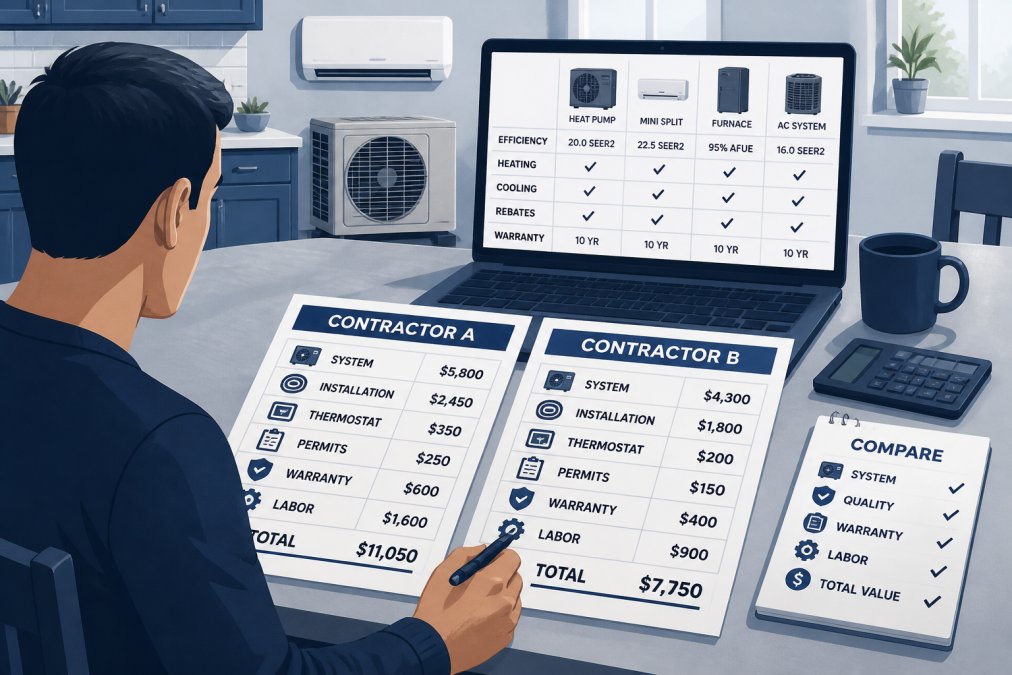
The Apples-to-Apples Bid Comparison Checklist
Use this checklist on every bid before you rank them. A bid that cannot answer a line is not necessarily bad, but it is not comparable until the contractor fills it in.
- Equipment model number and capacity, exact model, tonnage or BTU output, and efficiency rating (SEER2 for cooling, AFUE for furnaces, HSPF2 for heat pumps)
- Scope of work, what is being replaced, what is being reused (line set, ductwork, thermostat), and what is being added
- Labor hours and crew size, stated separately from equipment
- Permits, who pulls them and the actual fee amount
- Disposal, old unit and refrigerant removal cost, itemized
- Warranty, parts and labor coverage length, who honors it, and whether registration is required
- Commissioning, startup, refrigerant charge verification, and airflow testing included or extra
- Payment terms, deposit amount, progress payments, and final payment trigger
- Rebates and financing, disclosed as line items, not folded into the total
A Worked Example: Two Bids, Same Job
Suppose two contractors quote the same 3-ton heat pump replacement. Bid A is a single number: $9,400. Bid B is itemized: $4,100 equipment, $3,200 labor (two techs, one day), $350 permit, $150 disposal, $600 warranty reserve, $1,000 overhead and profit, total $9,400.
The totals match, but only Bid B lets you evaluate the markup. You can price-check the $4,100 equipment line against wholesale listings, confirm the $350 permit against the local fee schedule, and see that labor is priced for a one-day, two-person job.
When you have equipment pricing in hand, you can sanity-check the whole quote. You can buy HVAC units direct to see wholesale equipment costs and judge whether a contractor's equipment line is reasonable. You can buy HVAC units direct to see wholesale equipment costs and judge whether a contractor's equipment line is reasonable.
What an Itemized HVAC Estimate Should Show You
An itemized HVAC estimate breaks every charge into a separate line so you can see exactly what you are paying for. If a contractor will not itemize, treat that as a warning sign.
Here is what a fair estimate includes:
| Line Item | What It Should Show | Why It Matters |
|---|---|---|
| Equipment | Model, size, efficiency rating | Lets you price-check the unit |
| Labor | Hours and crew size | Reveals padded labor charges |
| Permits | Actual fee amount | Should match local fee schedule |
| Disposal | Old unit removal cost | Often a hidden charge |
| Warranty | Length and coverage | Confirms who backs the work |
A quote that shows only a total gives you nothing to negotiate against. You can compare mini split installation cost per room to judge whether a quote's labor and equipment lines are reasonable. Itemization gives you something to evaluate.
Questions to Ask an HVAC Contractor Before You Sign
Ask these questions before signing, and you will separate honest contractors from ones padding the bill:
- What is the exact model number and efficiency rating?
- Is this a flat-rate or cost-plus quote?
- How many labor hours are you estimating, and why?
- Who honors the warranty, you or the manufacturer?
- What is your policy if the system fails in the first year?
- Are permits and disposal included?
The answers help you understand how the contractor prices work. You can buy HVAC units direct with installation support to handle the work transparently. A cost-plus quote shows the actual cost plus a set percentage. A flat-rate quote combines costs into one number. Neither is automatically unfair, but knowing which one you are looking at changes how you negotiate.
Is It Cheaper to Buy HVAC Equipment Online?
Buying HVAC equipment online is often cheaper on the equipment line because you skip the contractor's equipment markup.
Here is the trade-off.
You can buy HVAC units direct at wholesale pricing, shipped to your door. Installation support is available in the Long Island area.
Watch out: Confirm the warranty terms before buying online. Some manufacturers require installation by a licensed professional to keep coverage valid.
How to Spot a Legitimate Markup Versus an Excessive One
A legitimate markup tracks the real cost of doing business; an excessive one is a number with no basis in the work performed. The difference usually shows up in the details, but you need a method, not just a vibe, to judge a specific quote.
What a Legitimate Markup Actually Pays For
Markup is not pure profit. On a typical residential replacement, the spread between equipment cost and the customer price funds:
- Labor and payroll burden, crew wages plus payroll taxes, workers' compensation insurance, and benefits
- Overhead, trucks, tools, inventory carrying cost, licensing, general liability insurance, office staff, and scheduling software
- Warranty reserve, money set aside to cover callback labor and parts when a system fails inside the coverage window
- Risk, the contractor absorbs the cost of a botched install, a damaged line set, or a manufacturer defect dispute
- Profit, the margin that keeps the business open and funds future hiring
A markup that looks large on the equipment line is often smaller than it appears once those buckets are counted. The question is not "is there a markup?", there always is, but "does the total installed price track the scope of work?"
A Practical Method for Judging a Specific Quote
Work through these steps on any bid that feels high:
- Price-check the equipment line. Look up the model number against wholesale listings. A reasonable equipment markup covers handling, warranty risk, and inventory, not a multiple of the wholesale price.
- Check labor against scope. Ask how many techs, how many hours, and what tasks are included. A one-day, two-person replacement is a known quantity; labor priced for three days on the same job is a flag.
- Verify pass-through fees. Permit and disposal charges should match the local fee schedule and a realistic disposal cost. Inflated pass-throughs are one of the easiest places to pad a total.
- Confirm what the warranty covers. Parts-only coverage is worth less than parts-and-labor. A quote that charges a premium price but offers a short parts-only warranty is not delivering proportional value.
- Compare the total to the scope, not to the lowest bid. The lowest bid is not automatically fair, and the highest is not automatically padded. Rank bids by what is included, then by price.
The Federal Trade Commission's consumer guidance offers general protection advice for home improvement contracts, including your right to compare bids. Use it.
If a quote feels inflated, ask the contractor to justify each line. A fair contractor will explain the numbers. One who will not is telling you something.
Get a Transparent Quote from The HVAC Super Store
The most reliable way to avoid an inflated markup is to know the real equipment cost before you sign anything. The HVAC Super Store sells heat pumps, mini splits, furnaces, and AC systems at wholesale pricing, shipped straight to your door.
Here is what we offer:
- Wholesale pricing on a wide selection of equipment, parts, and accessories
- Direct-to-door shipping so you see the true equipment cost
- Installation support for customers in the Long Island area
Whether you are a homeowner comparing bids or a contractor sourcing systems for a job, you can review our equipment offerings. You can buy HVAC units direct and request a quote to see how direct pricing and installation support work for your project.
Frequently Asked Questions
Why do HVAC contractors mark up equipment?
Contractors mark up equipment to cover business costs beyond the hardware itself: liability insurance, warranty support, truck inventory, scheduling, and the labor to size and commission the system. A markup is not automatically a red flag. The problem starts when the markup is hidden inside a lump-sum price and you cannot see what the equipment actually costs. Asking for an itemized HVAC estimate separates the equipment line from labor and overhead so you can judge whether the total is fair.
Can I buy an HVAC system myself and hire an installer?
Yes, many homeowners buy equipment directly and hire a licensed installer for the labor. The catch is warranty coverage: some manufacturers require installation by a licensed professional to keep the warranty valid, so confirm the terms before you order. You also take on responsibility for sizing the system correctly. Buying online works best when you have the load calculation done first, then purchase the exact model the contractor specifies.
How can I tell if an HVAC quote is overpriced?
Compare the equipment line against the model number's listed price and check whether the labor and overhead charges are explained. A quote that bundles everything into one number with no breakdown is harder to evaluate. Get at least three bids on the same scope, and look for a written itemized HVAC estimate that lists equipment, labor, permits, and any extras separately. If one bid is far above the others with no added scope, ask the contractor to walk you through the difference.
Will an HVAC contractor install equipment I purchased myself?
Many independent contractors will, though some decline because they cannot warranty equipment they did not supply. Ask upfront and get the answer in writing. Expect the labor rate to be higher when you supply the equipment, since the contractor loses the equipment margin. Have the model number, size, and specifications ready before you call so the contractor can confirm it fits your home and ductwork.
Comparing HVAC quotes does not have to be a guessing game. Get the equipment cost in hand, demand itemized estimates, and ask the right questions. Get started with The HVAC Super Store and price your next system with confidence.