 how-to
Mini Split Installation Cost per Room: What to Expect
Last Updated: October 26, 2026
Quick Summary
Mini split installation cost per room ranges from about $2,000 to $6,000 for a single-zone system, while multi-zone projects run roughly $2,025 to $5,250 per room. Per-room cost falls as zone count rises because one outdoor condenser is shared across several indoor heads, though each head still needs its own line set, mounting, wiring, and refrigerant charge.
- Equipment and labor are separate line items; ask for the split so you can compare bids.
- Labor covers mounting, line-set routing, electrical, evacuation, charging, and testing.
- Multi-zone per-room cost drops because one condenser serves several indoor heads.
- Line-set runs beyond the included 15-25 feet commonly add a few hundred dollars per zone.
- Many manufacturers require a licensed professional to keep the warranty valid.
Table of Contents
- What Drives Mini Split Installation Cost per Room
- Equipment Cost vs. Installation Labor
- Mini Split Installation Labor Cost: What Contractors Charge
- Single-Zone Mini Split Installation Cost for One Room
- Multi-Zone Mini Split Installation Cost: Is Per-Room Pricing Lower?
- Mini Split Sizing by Room: How BTU Requirements Affect Price
- Hidden Cost Factors: Line Sets, Electrical, and Installation Complexity
- DIY vs. Professional Installation: Safety, Warranty, and Real Savings
- Get a Room-by-Room Quote from The HVAC Super Store
- Frequently Asked Questions
What Drives Mini Split Installation Cost per Room
Mini split installation cost per room depends on four things: the equipment you buy, the labor your installer charges, how many zones the system serves, and how difficult the line-set run is. Equipment is the predictable part. Labor and site conditions are where budgets move.
The biggest mistake homeowners make is pricing a system before pricing the install. A single-zone unit and a five-zone unit can look similar on a spec sheet and land in completely different places once a contractor quotes the work.
Below, we'll break down what each cost component actually covers, how single-zone and multi-zone pricing compare per room, and what to check before you sign a quote.
Equipment Cost vs. Installation Labor
Equipment and labor are separate line items, and confusing them is the fastest way to blow a budget. Equipment is the hardware: indoor unit, outdoor condenser, line set, and accessories.
Equipment pricing scales with capacity and zone count. A larger condenser or an extra indoor head raises the hardware bill. Labor scales with complexity instead.
Watch out: some quotes bundle equipment and labor into one number so you can't compare bids. Ask for the split. A quote that separates equipment cost from installation labor is the one you can actually evaluate.
Mini Split Installation Labor Cost: What Contractors Charge
Mini split installation labor cost is usually the largest variable in the project.
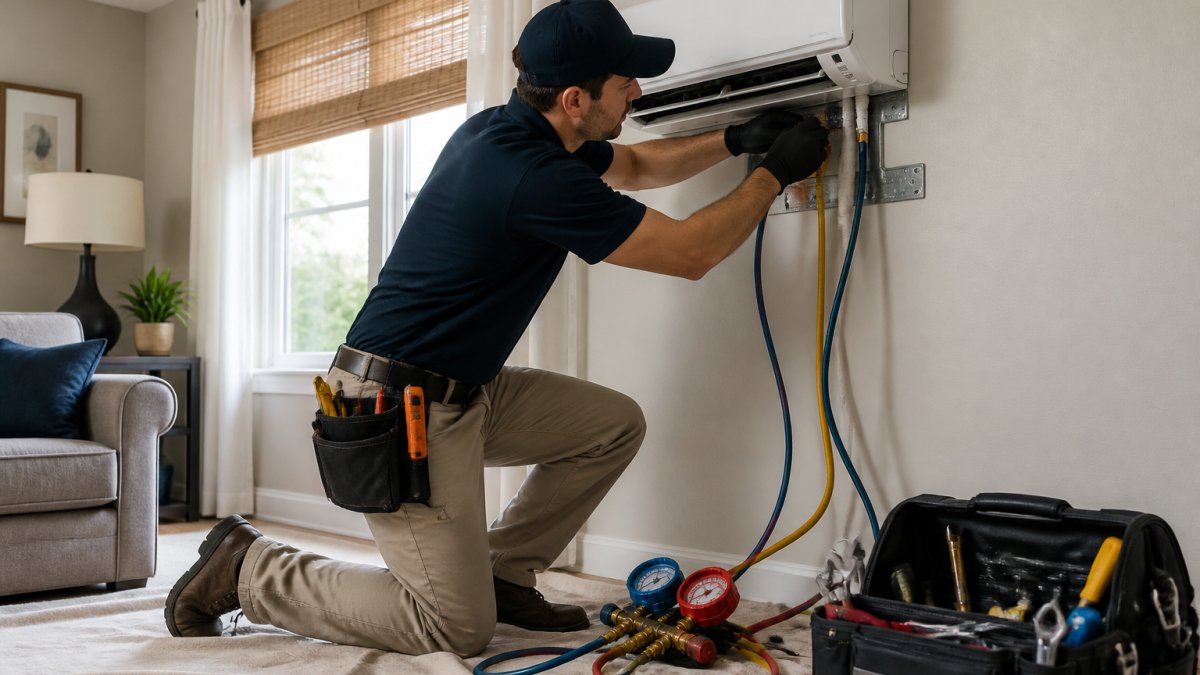
What most guides miss is that labor is not one task. It's several: mounting the indoor unit, setting the outdoor condenser, running the line set, pulling electrical, evacuating and charging the refrigerant lines, and testing.
A common mistake is assuming the cheapest labor quote is the best value. Low labor often signals skipped steps, like a rushed vacuum on the refrigerant lines.
Single-Zone Mini Split Installation Cost for One Room
Single-zone mini split installation cost for one room is the simplest project to price, and the easiest to get wrong. One indoor unit, one outdoor unit, one refrigerant circuit. Fewer parts means fewer labor hours and a shorter project duration.
The variables that move a single-zone quote:
- System size: a 9,000 BTU or 12,000 BTU unit for a bedroom costs less in equipment than an 18,000 BTU unit for a large living space
- Line-set length: a short run to an exterior wall is cheaper than a long route around the house
- Electrical work: a nearby panel keeps wiring simple; a distant one adds labor
- Mounting: a standard wall-mounted unit is routine; a ceiling cassette or floor unit takes more time
Price a single-zone system as equipment plus labor plus any add-ons. If you want financing to spread the upfront cost of a one-room install, browse the systems at The HVAC Super Store.
Multi-Zone Mini Split Installation Cost: Is Per-Room Pricing Lower?
Multi-zone mini split installation cost per room is often lower than single-zone pricing, but only when the rooms share one condenser.
The clearest way to see it is a transparent, assumption-based breakdown. The table below separates equipment, labor, and common add-ons for one through four rooms.
Assumptions behind the per-room ranges:
- Standard wall-mounted indoor heads; no ceiling cassettes or floor consoles
- Line-set runs of roughly 25 feet or less to an exterior wall
- An existing electrical panel with capacity for a dedicated circuit near the install
- No major wall or ceiling repair, and ground-level outdoor unit placement
- Professional installation by a licensed contractor, including evacuation and testing
| Rooms / Zones | System Type | Equipment (USD) | Labor (USD) | Typical Add-Ons (USD) | Installed Total (USD) | Approx. Cost per Room (USD) |
|---|---|---|---|---|---|---|
| 1 room | Single-zone | $1,200-$2,500 | $800-$2,000 | $0-$1,500 | $2,000-$6,000 | $2,000-$6,000 |
| 2 rooms | Multi-zone (2 heads, 1 condenser) | $2,500-$4,500 | $1,800-$3,500 | $0-$2,500 | $4,300-$10,500 | $2,150-$5,250 |
| 3 rooms | Multi-zone (3 heads, 1 condenser) | $3,500-$6,500 | $2,700-$5,000 | $0-$3,500 | $6,200-$15,000 | $2,070-$5,000 |
| 4 rooms | Multi-zone (4 heads, 1 condenser) | $4,500-$8,500 | $3,600-$6,500 | $0-$4,500 | $8,100-$19,500 | $2,025-$4,875 |
Read the last column, not the total.
Here is the trade-off in plain terms:
| System Type | Equipment per Room | Labor per Room | Best For |
|---|---|---|---|
| Single-zone | Higher (own condenser) | Lower (simple job) | One room, tight budget |
| Multi-zone | Lower (shared condenser) | Higher (more runs) | Several rooms at once |
A common pattern is that multi-zone wins on total cost at three or more rooms, while single-zone stays cleaner for one room. The crossover point depends on how far apart the rooms are and how hard the line-set runs are.
If you are weighing a multi-zone system against several single-zone units, browse the multi-zone systems at The HVAC Super Store to see current equipment pricing before you request labor bids.
Mini Split Sizing by Room: How BTU Requirements Affect Price
Mini split sizing by room starts with BTU, and BTU drives price. BTU, or British thermal units, measures cooling and heating capacity. Undersize the unit and it runs constantly without keeping up. Oversize it and it short-cycles, which wastes energy and wears the compressor.
A rough starting point many installers use is capacity matched to square footage, then adjusted for the room. But square footage alone is not enough. Insulation, window count, sun exposure, and local climate all shift the real load.
Room Size, Insulation, Windows, and Climate
Sizing is where a generic estimate fails. A 1970s house with thin insulation and single-pane windows needs more capacity than a newer build. A room with west-facing glass gains more heat in the afternoon.
For a deeper walkthrough on load calculations, read how to calculate HVAC system load for your home. If you want to size the right BTU capacity for each room before pricing it out, use the sizing tools at The HVAC Super Store.
Hidden Cost Factors: Line Sets, Electrical, and Installation Complexity
The line set, the electrical run, and installation complexity are where quoted prices drift.
Common add-on costs and when they appear:
- Line-set length beyond the standard run: most systems include a set length (often 15-25 feet). Extra refrigerant line, insulation, and labor for a longer route commonly add a few hundred dollars per zone, and the amount climbs with distance and difficulty.
- Electrical work: a dedicated circuit is standard, but a distant panel, a full panel, or a required panel upgrade adds labor and materials. Panel work is one of the largest single add-ons a quote can carry.
- Condensate drainage: a gravity drain to the exterior is simple; a condensate pump is needed when the indoor head sits below the drain route or in an interior wall, adding equipment and labor.
- Wall and ceiling routing: fishing lines through finished walls, plaster, or brick takes more time than an exterior run. Patching and painting after the install is often a separate line item.
- Outdoor unit placement: a ground-level pad is easy; a roof, a wall bracket, or a tight side yard adds mounting hardware and access time.
- Permits and inspections: many jurisdictions require a permit for HVAC work, and the fee and inspection time may appear as a separate charge.
- Garage and unconditioned-space installs: a garage or unconditioned space can need extra mounting, insulation, and freeze protection, which adds cost beyond a standard interior room.
Installation complexity is the wildcard. Two homes with identical room sizes can produce very different quotes based on how the lines and wiring have to travel.
Quote checklist, compare bids line by line:
- Equipment model, capacity (BTU), and SEER2 rating per zone
- Included line-set length, and the per-foot charge beyond it
- Electrical scope: dedicated circuit, panel capacity, and who pulls the permit
- Condensate route and whether a pump is included
- Outdoor unit placement and mounting hardware
- Wall, ceiling, and finish repair, included or excluded
- Evacuation, leak test, and refrigerant charge, confirm these are in the labor line
- Warranty terms and whether registration requires a licensed installer
A bid that answers all eight is the one you can actually evaluate. A bid that skips several is where the surprise costs hide.
If you want to price the equipment side before you collect labor bids, browse systems and buy direct at wholesale pricing so you can separate hardware cost from installation cost in every quote you receive.
DIY vs. Professional Installation: Safety, Warranty, and Real Savings
DIY installation looks like a way to cut cost, and for some homeowners it is. But refrigerant handling, electrical work, and warranty terms change the math.
A common mistake is buying a system, then discovering the warranty requires a licensed installer. Check the terms before you order.
Our take: buy the equipment at wholesale pricing, then use a licensed installer for the parts that carry real risk. That combination protects the warranty and your safety without paying retail markup on the hardware.
Get a Room-by-Room Quote from The HVAC Super Store
The reliable way to price a project is a room-by-room quote, not a guess. List each room, its size, its windows, and how many zones you need. That detail lets an installer give you a real number instead of a range.
We sell heat pumps, mini splits, furnaces, and AC systems direct at wholesale pricing, shipped to your door, with installation support available in the Long Island area. Get a room-by-room quote from The HVAC Super Store. To see current equipment pricing before you commit, browse systems and buy direct at wholesale pricing.
Frequently Asked Questions
How much does it cost to install a mini split in one room?
A single-zone mini split installation cost per room depends on the equipment size, line-set length, and local labor rates. Expect to pay for the indoor unit, outdoor condenser, mounting hardware, and several hours of licensed installer time. Prices vary widely by region and system capacity, so request an itemized quote that separates equipment from labor and lists any electrical or line-set add-ons.
Does installing a mini split in multiple rooms cost less per room?
Often yes, because a multi-zone system uses one outdoor condenser for several indoor units, which can reduce equipment cost per room compared with buying separate single-zone systems. Labor may also be slightly lower per room when line sets are run in one visit. However, multi-zone systems require more complex refrigerant balancing and longer line runs, so the savings are not guaranteed. Compare quotes for both configurations before deciding.
What size mini split do I need for each room?
Sizing depends on square footage, ceiling height, insulation, window area, and local climate. A common starting point is 20 BTU per square foot, so a 300-square-foot room might need a 9,000 BTU unit, while a 500-square-foot room may need 12,000 BTU. Oversizing wastes energy and can cause poor humidity control. A contractor can perform a load calculation to match each room precisely.
Is DIY mini split installation cheaper than hiring a pro?
DIY can save on labor, but mini splits require refrigerant handling, vacuum evacuation, and electrical work that often must be performed by a licensed technician to keep the manufacturer warranty valid. Improper installation can lead to leaks, reduced efficiency, and safety hazards. For a realistic comparison, factor in tool rental, permit costs, and the risk of voiding coverage before choosing DIY over a professional installer.
Pricing a mini split per room is not about finding one magic number. It's about separating equipment from labor, sizing each room correctly, and catching the add-ons before they catch you. That's the work The HVAC Super Store helps you do: wholesale equipment, direct-to-door shipping, and installation support for local customers, so your quote reflects the real job. Get started with The HVAC Super Store and price your project room by room.